By BirdClose™ | Closer to Nature. Closer to What Matters.
There is a moment that every window birder remembers.
It is not the time they drove three hours to a nature reserve, or the morning they hiked deep into a woodland with binoculars and a packed lunch. It is a quieter moment than that — and a more surprising one. It is the first time a wild bird landed just inches from their face, separated only by a pane of glass, and looked back at them with curious, bright eyes.
That moment changes people.
It turns out you do not need to travel anywhere to experience the wonder of wildlife. You do not need specialist equipment, years of experience, or even a garden. All you need is a window, the right feeder, and the knowledge to use it well.
This guide will walk you through everything you need to know about window bird feeding — from why it works, to how to choose the right feeder, to what birds you are likely to see. Think of it as your starting point. The deeper journey — the day-by-day process of attracting, building trust with, and establishing a thriving community of birds at your specific window — that is something we cover in detail inside the BirdClose 7-Day Guide, which comes with every feeder.
But let us start at the beginning.
Garden bird feeding has been a beloved hobby for generations. Pole-mounted feeders, hanging fat balls, seed trays on the lawn — these are familiar sights in back gardens across the UK, North America, Canada, Europe, and Australia. And they work, in their way.
But they have a fundamental limitation: distance.
A garden feeder seen from across a lawn puts birds at a remove. You can see that something is there — a flash of colour, a movement in the branches — but you cannot see the individual markings on a sparrow’s wing, the precise moment a blue tit selects one seed over another, or the bright, intelligent eye of a robin assessing its surroundings. The experience is pleasant but passive. You are watching wildlife through a kind of invisible barrier — not glass, but space.
Window feeding eliminates that barrier entirely.
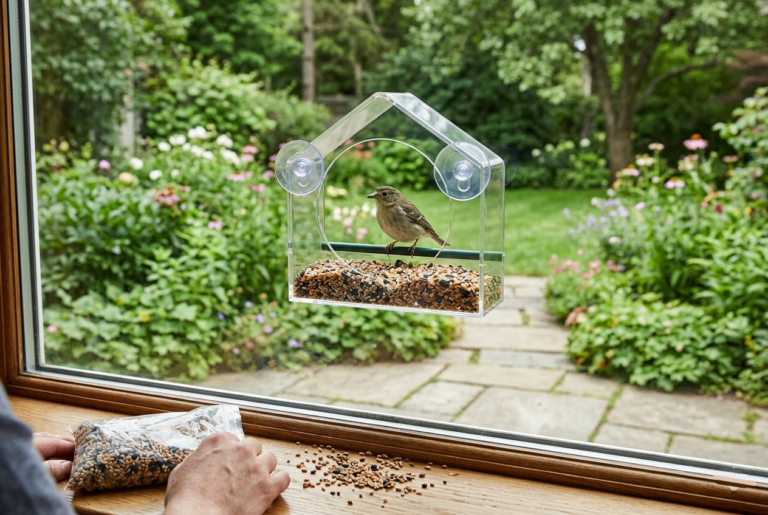
When a bird lands on a window-mounted feeder, it is inches from your face. You are not observing from a distance. You are present in a way that feels genuinely remarkable, especially the first time it happens. The intimacy is the entire point — and once you have experienced it, a garden feeder thirty feet away feels like watching a film from the back row of a very large cinema.
The honest answer is: almost everyone.
Families with young children find that a window feeder becomes one of the most reliable sources of wonder in the home. Children who cannot sit still for a nature documentary will press their nose against the glass for twenty minutes, watching sparrows work through a tray of seeds. The questions they ask — why does that one have different colours, where do they go at night, why do they bob their heads — are the beginning of genuine scientific curiosity. No screen required.
People who work from home have discovered that a window feeder within eyeline of the desk is one of the most effective tools for mental recovery during the working day. More on this shortly.
Older adults find that window feeding provides both companionship and routine. The birds arrive at predictable times. They become familiar. You begin to recognise individuals. The relationship — however one-sided it may technically be — provides a quiet, consistent source of joy that many describe as one of the best things about their daily life.
People with limited outdoor access — whether due to illness, mobility issues, or simply living in an apartment without a garden — gain access to the natural world in a way that was previously unavailable to them. A window feeder works on the fourteenth floor just as well as it does at ground level, provided there are birds in the area.
Experienced birders find something new: the chance to observe behaviour at a level of detail that no garden feeder can match. When you can see a bird’s eye, you are seeing something different from what binoculars at a distance provide.
This is not a vague, feel-good claim. Researchers have been studying the relationship between bird activity and human wellbeing for years, and the findings are consistently striking.
Studies consistently show that people living in areas with more birds, shrubs, and trees report significantly lower rates of depression, anxiety, and stress than those living in bird-poor environments. The effect is not explained entirely by green space — the presence of birds specifically, and the sounds and movements associated with them, appears to have an independent positive impact on human mental health.
The mechanism behind this is something psychologists call “soft fascination.” Unlike the sharp, demanding focus required by a work task or a smartphone notification, soft fascination is a state of gentle, effortless attention. Your mind is engaged but not strained. Your focus is held but not forced. It is, in neurological terms, the closest thing to active meditation that most people experience without consciously trying.
Watching birds from a window produces exactly this state. And unlike a formal meditation practice, it requires no effort, no scheduling, and no particular skill. It is simply there, on the other side of the glass, whenever you choose to look.
For people working from home, the benefits are measurable in practical terms. Looking away from a screen to watch a bird feed for sixty seconds is not a distraction — it is a micro-recovery. It reduces eye strain. It interrupts the cortisol accumulation of concentrated screen time. It restores the kind of diffuse, rested attention that makes the next block of focused work more productive. Many remote workers who install a window feeder near their desk describe it as one of the best productivity decisions they ever made — which is not the outcome they were expecting.
The birds, of course, do not know any of this. They are simply eating. But their indifference to your deadline is, in its own way, part of what makes watching them so restorative.
To attract birds to a new feeder, it helps to understand how birds locate food in the first place. They do not wander randomly. They are systematic, habitual, and remarkably consistent.
Birds map their territory. They identify reliable food sources and build daily circuits around them — particular routes flown at particular times, stopping at known feeding stations in a predictable sequence. A bird that discovers your feeder on Monday will return on Tuesday. If the food is still there, it returns on Wednesday. Within a week, your feeder is part of its daily routine.
The catch is that initial discovery. Birds find new food sources in two main ways: visually, by spotting something that looks like food from a flight path they already use, and socially, through what birders often call the “scout” system. A bold individual bird discovers a new source and communicates this to others in the local flock. This is why a feeder can be completely quiet for several days and then suddenly receive multiple visitors in a single morning.
The first visitor — the scout — is a significant moment. When it arrives, lands briefly, perhaps takes a seed, and leaves, this is not failure. This is the process working exactly as it should. The scout is assessing the location for safety and reporting back. Be patient. The flock follows.
Birds are prey. Every decision they make — where to land, how long to stay, whether to approach something new — is filtered through a constant, background awareness of predators. Understanding this changes how you interpret everything about window bird feeding.
A bird that lands near your feeder and flies away without eating is not uninterested. It is assessing. A bird that visits repeatedly but only briefly is building trust incrementally. A bird that finally settles in and feeds without apparent anxiety has decided, based on its own careful observation, that your window is safe.
This trust-building process cannot be rushed. What it can be is supported — through the right placement, the right food, and the right level of stillness and patience on your part. The full process of how to build that trust, day by day, is something we walk through in detail in the BirdClose 7-Day Guide. But understanding that the process exists, and that it follows a predictable pattern, removes the discouragement that causes many first-time window birders to give up just before things get interesting.
Bird behaviour changes significantly across the seasons, and the best window birders adjust their approach accordingly.
Winter is simultaneously the easiest and most important season for window feeding. Birds are in survival mode — energy demands are high, natural food is scarce, and the birds are slightly less cautious than at other times of year. A new feeder installed in October or November will typically attract visitors faster than one installed in June. Winter is also the time when your feeder makes the most meaningful difference to your local bird population.
Spring brings a shift in priorities. Reproduction takes over from survival. Birds are singing, establishing territory, building nests, and eventually raising chicks. The energy demands on adult birds during this period are enormous, and a reliable window feeder becomes a genuinely important resource. Spring also introduces a safety consideration that many people are unaware of — one that we cover in detail inside the guide.
Summer is the quietest season for feeders, as natural food is most abundant. This does not mean you should stop feeding — regular visitors will continue to return — but it does mean checking seed freshness more carefully, as warm weather accelerates spoilage.
Autumn is an often-overlooked window of opportunity. Birds are actively seeking and mapping food sources in preparation for winter, building the mental circuits they will rely on during the coldest months. A feeder installed in autumn will often attract visitors faster than one installed at any other time of year.
The window feeder market ranges from impressively well-engineered products to cheap imitations that fail within weeks. Knowing what to look for prevents the frustration of a feeder that falls off in the first frost, yellows within a season, or simply never attracts the birds you were hoping for.
Material quality determines longevity and view. Premium window feeders are made from high-grade, crystal-clear acrylic. This material weathers well, maintains its transparency through multiple seasons, and gives you an unobstructed view of every bird that visits. Cheaper plastics yellow and scratch quickly, degrading both the feeder’s appearance and — more importantly — your view through it.
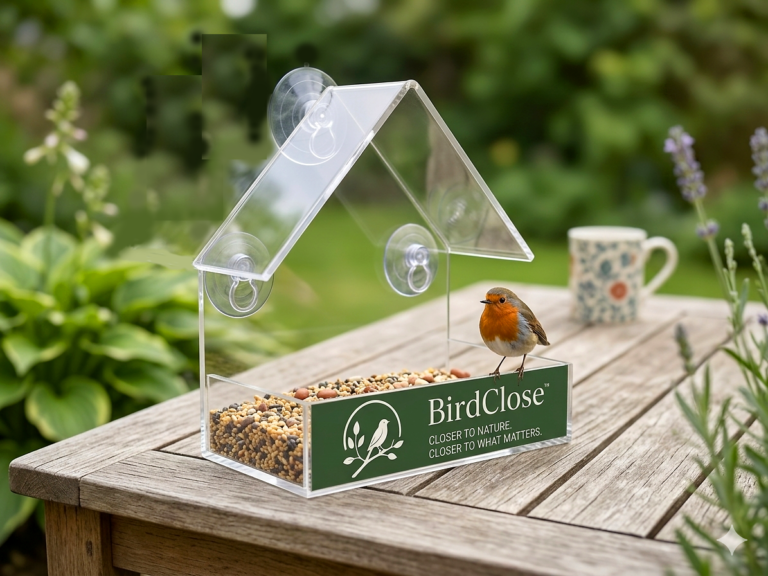
Suction cups are the foundation of everything. They are what keeps your feeder attached to your window. Poor suction cups fail in cold temperatures, under the weight of a full seed tray, or after the first heavy rainfall. Quality feeders use industrial-grade suction cups that grip clean glass firmly and maintain their hold across a wide range of conditions. The arrangement of the cups matters too — three cups in a triangular formation provide significantly more stability than two aligned horizontally.
Roof design affects how long seeds stay fresh. A well-designed roof deflects rain away from the seed tray. A poorly designed or absent roof means wet seeds, which spoil quickly and which birds actively avoid. This single design feature has a disproportionate impact on how useful the feeder actually is in real-world conditions.
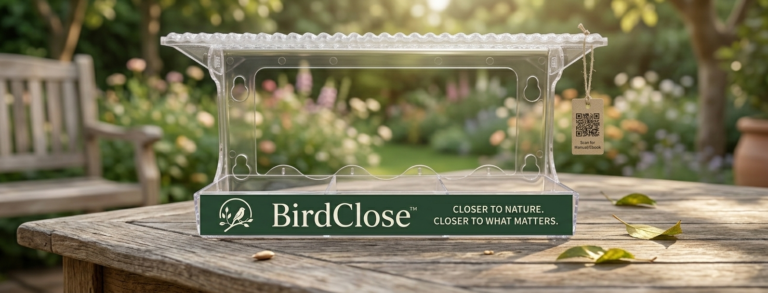
Size should match your goals and your window. Compact feeders are ideal for smaller windows, minimalist aesthetics, and close-up observation of individual birds. Wider, panoramic feeders accommodate more birds simultaneously and generate more activity during busy periods — particularly useful during winter when competition for food is high.
At BirdClose, we design our feeders around the principle that the feeder should disappear — that the birds should be the entire experience, not the hardware.
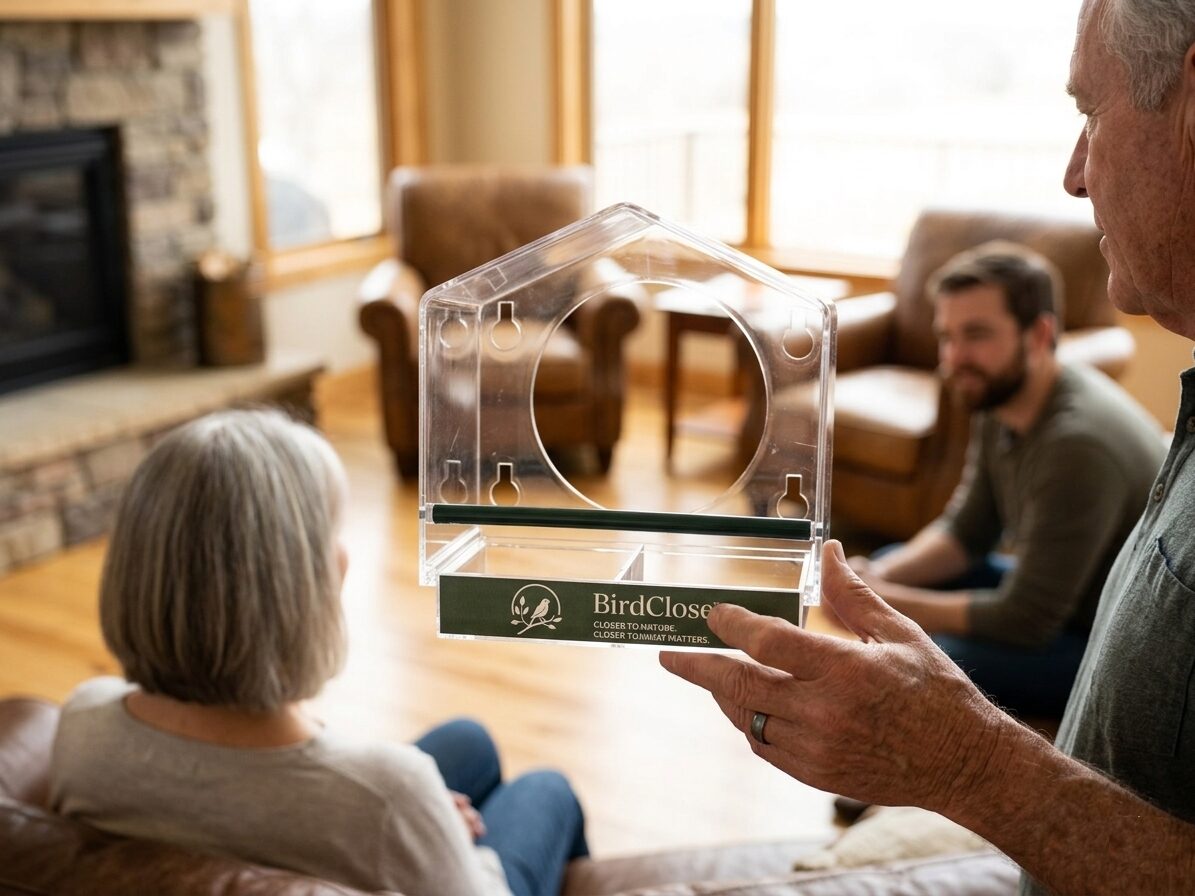
Our compact models prioritise transparency and simplicity. With clean lines and no decorative elements that distract from the view, they sit on the glass almost invisibly, putting all the focus on your feathered visitors. Our arched-roof models combine excellent rain protection with a more traditional aesthetic — the pitched roofline and coloured perch create a clear landing target that birds find quickly.
The feeders in our range use industrial-grade suction cups, drainage-optimised trays, and premium acrylic chosen for long-term clarity. They are designed to be the last window feeder you need to buy.
Every BirdClose™ feeder comes with our complete 7-Day Guide — and if you can’t wait, you can download it right now only for $4.99 and start learning the secrets before your first bird even arrives.
This is one of the most common mistakes new window birders make, and understanding it saves a great deal of frustration.
Most cheap mixed bird seed products contain a high proportion of filler seeds — wheat, milo, and red millet — that the majority of garden songbirds will not eat. These seeds are nutritionally insufficient for most songbird species, and birds know it. A tray filled with cheap mix will be picked through, with preferred seeds eaten and the rest left to get wet, mouldy, and unattractive.
The result is a feeder that looks stocked but is effectively empty from the birds’ perspective. It is also wasteful — you are paying for seed that serves no purpose.
Sunflower hearts — hulled sunflower seeds with the shell already removed — are the single best food you can offer at a window feeder. They are one hundred percent edible, create no mess, and are nutritionally dense enough to attract a very wide range of species. They are the gold standard of window bird feeding for good reason.
Black oil sunflower seeds (with shells) are an excellent and slightly cheaper alternative. The thin shells of the black oil variety are easy for most songbirds to crack, and the seed inside is highly nutritious.
Peanut pieces — not whole peanuts, but broken granules — are calorie-dense and attract a particularly wide range of species including woodpeckers, nuthatches, and many finches. We specify pieces rather than whole peanuts for important safety reasons explained in detail in the 7-Day Guide.
Nyjer seeds are small, oil-rich, and exceptionally attractive to finches. If you want goldfinches at your window, nyjer is your best tool.
Suet pellets are rendered fat mixed with seeds or insects, and they attract species that do not typically visit seed feeders — making them a useful addition if you want to broaden the range of your visitors.
Some commonly offered foods are actively harmful to wild birds. Salt and salted foods, in even small quantities, can be toxic to small songbirds whose kidneys cannot process sodium at human food concentrations. Bread and baked goods are nutritionally empty and can cause harm in other ways. Whole peanuts during nesting season create a risk that is explained — with the reasoning behind it — in the guide.
The rule of thumb is simple: if it comes from your kitchen rather than a specialist bird food supplier, think carefully before offering it.
The species attracted to your window feeder will depend on where you live, but certain birds are reliable visitors across the English-speaking world.
House Sparrows are among the most common and reliable window feeder birds in urban and suburban environments across the UK, North America, Canada, and Australia. They are sociable, bold, and often the first species to discover a new feeder. They travel in loose groups and create a pleasant bustle of activity that many window birders find deeply satisfying.
Blue Tits and Great Tits (UK and Europe) are acrobatic, colourful, and endlessly entertaining. Blue tits in particular adapt quickly to close human proximity and will return multiple times a day once they have established a routine at your feeder.
Chickadees (North America) are the New World equivalent of the tit family — small, quick, and among the boldest birds at any feeder. Black-capped chickadees are particularly famous for their comfort around humans, and they are often among the first birds to investigate a new feeding station.
Robins, European Robin in the UK and American Robin in North America, are among the most beloved garden birds and, with patience, will visit a window feeder for the right food. Their tameness, once they feel safe, is remarkable — and seeing a robin feed at arm’s length is one of the most charming experiences window birding offers.
Goldfinches are among the most visually spectacular window feeder visitors. Combination of red face, gold wing bar, and black-and-white markings of European Goldfinch makes them immediately recognisable. They are strongly attracted to nyjer seed and will visit reliably once they have established your feeder as part of their circuit.
Nuthatches, like the White-breasted Nuthatch have a distinctive habit of walking head-first down vertical surfaces. At a window feeder, this behaviour is extraordinary to watch — they will cling to the side of the feeder in orientations that seem to defy gravity, selecting seeds with apparent deliberateness before departing.
Woodpeckers — great spotted woodpeckers in the UK, downy or hairy woodpeckers in North America — occasionally visit window feeders, particularly for suet. Their arrival is always an event, and it is the kind of experience that reminds you why you installed the feeder in the first place.
These are just the beginning. Depending on your location, season, and the food you offer, the range of species that discover your window can expand well beyond these regulars. Part of what makes window birding so absorbing over the long term is exactly this unpredictability — the sense that any morning, something new might arrive.
We want to be honest with you about something: the first week of window bird feeding requires patience. Most new feeders are not busy from day one. This is normal, it is expected, and it is not a sign that anything is wrong.
Birds are cautious by nature. They assess new food sources carefully before committing to them. The process follows a pattern — discovery, scouting, gradual trust-building, routine — and that pattern takes time to unfold. Understanding the pattern in advance means that the quiet first days feel like progress rather than failure, because they are.
The complete day-by-day breakdown of what to expect — including the specific techniques that accelerate each stage, the exact things to watch for as signs of progress, and the common mistakes that slow the process down — is what the BirdClose 7-Day Guide is designed to provide. It comes with every feeder, and the feedback we receive most consistently from customers is that having that guide changed their experience entirely. Not because it is complicated, but because knowing what is happening at each stage, and why, makes the whole process feel intentional rather than hopeful.
What we can tell you here is this: if you install a good feeder in the right place, fill it with the right food, and give it time, birds will come. The first visitor will arrive. And when it does — when that first small, wild creature lands on your glass and turns its bright eye toward you — you will understand why so many people, once they experience this, never stop.
Not all windows are equal for bird feeding. The ideal location has a few key characteristics that significantly affect how quickly birds discover the feeder and how comfortable they feel using it.
Proximity to cover is the most important factor. Birds feel safest when they can reach shelter quickly — a tree, a large shrub, a dense hedge — if a predator appears. A feeder within ten to fifteen feet of suitable cover will attract more birds and see longer feeding visits than one exposed in the middle of open space. The cover does not need to be in your garden — a neighbour’s tree visible from the window counts.
Reduced indoor disturbance near the glass matters more than most people realise. Sudden movement inside the house, seen as silhouettes through the glass, is one of the most common reasons birds leave a feeder quickly or stop visiting entirely. A quieter room — a study, a bedroom, a sitting room with relatively still occupants — is more suitable than a busy kitchen or hallway. Sheer curtains can solve this problem in otherwise ideal locations, diffusing your silhouette while still allowing you to see out clearly.
Your own sightline deserves consideration too. The best feeder is one outside a window you actually sit near. A feeder outside a window you rarely pass serves the birds well but does little for you.
Correct installation takes ten minutes and makes the difference between a feeder that stays mounted reliably for years and one that falls off unexpectedly. The critical step — one that most people underestimate — is cleaning the glass before mounting.
Suction cups require a clean, smooth surface to create an effective seal. Dust, grease, or even fingerprints on the glass reduce suction significantly. Use rubbing alcohol on a clean cloth to wipe the mounting area thoroughly, allow it to dry completely, and then press each suction cup firmly into the glass from the centre outward, pushing all air out from beneath it.
Test the mounted feeder before loading it with seeds. A correctly mounted feeder should feel completely solid — no shifting, no flex. If it moves, remove it, re-clean both the glass and the cup surfaces, and try again.
Window bird feeding is, at its core, an act of attention. It is a choice to notice the living world on the other side of your glass — to make a small gesture toward it, and to see what comes back.
What comes back, in our experience and in the experience of BirdClose customers, is more than birds. It is a reliable source of daily wonder. It is a reason to sit quietly for a few minutes. It is the realisation, repeated every morning, that the natural world is not something you have to travel to find. It is right there, on the other side of the glass, waiting.
Start with one feeder. Fill it with the right seeds. Put it in the right place. The rest unfolds on its own.
Every BirdClose™ feeder includes our complete 7-Day Guide to Bringing Nature Closer — a detailed, day-by-day roadmap to attracting your first visitors, building their trust, and establishing a thriving window sanctuary. It covers everything from the exact placement techniques that make birds feel safe, to the seasonal feeding adjustments that keep your window active year-round.
Explore the full BirdClose range at birdclose.com
Share your first visitor with #BirdCloseMoment
© 2026 BirdClose™ | Closer to Nature. Closer to What Matters.