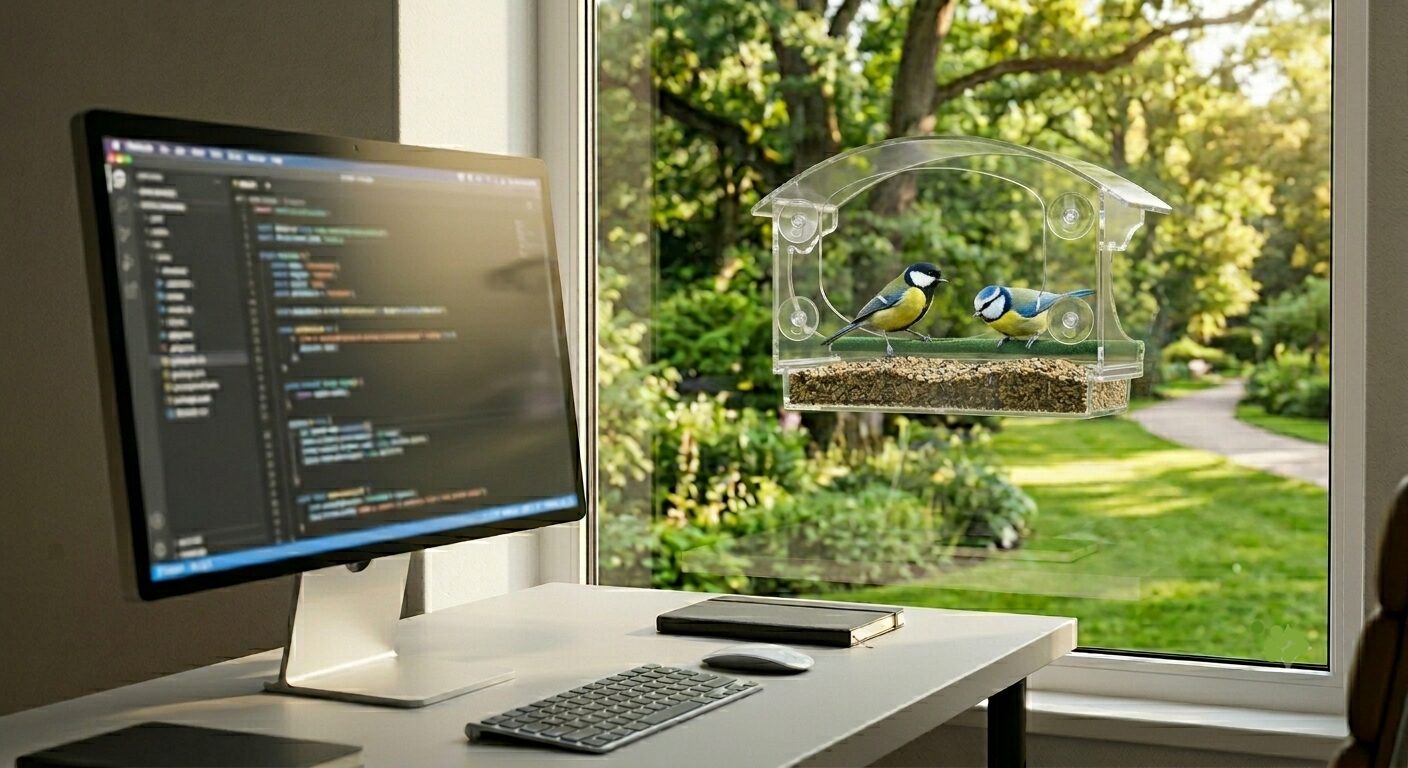
Step into any highly optimized modern home office, and you will likely find a masterclass in human engineering. We invest in premium ergonomic chairs tailored to our backs, dual-monitor arms to keep our necks aligned, mechanical keyboards for our wrists, and smart ambient lighting to protect our vision. We systematically upgrade every physical component of our workspace in the absolute pursuit of peak performance and sustained well-being.
Yet, by 2:00 PM, a familiar and oppressive cloud settles over the remote professional. Your eyes feel dry, heavy, and strained. Your ability to focus on complex tasks, code, or creative strategies deteriorates into a state of passive scrolling. Your brain feels wrapped in wool, and the afternoon coffee offers nothing more than a brief, jittery spike followed by an even deeper cognitive crash.
This is not a failure of willpower. It is a biological tax. It is Screen Fatigue—a contemporary manifestation of cognitive depletion driven by a fundamental mismatch between our evolutionary biology and our current digital environment.
For years, the technology industry has insisted that the solution to digital fatigue is more digital technology. We are told to buy blue-light-blocking lenses, download focus apps, subscribe to mindfulness platforms, or purchase secondary e-ink displays.
But the most profound, life-changing upgrade you can make to your home office does not require a software update, a lithium-ion battery, or a subscription model. It doesn’t look like a tech gadget at all; it looks like a window to the living world.
The ultimate productivity and wellness tool for the modern professional is a premium, ultra-clear acrylic window bird feeder. By bringing the unpredictable, dynamic, and restorative architecture of nature directly to your desk’s eye level, you completely change your relationship with your workspace.
When our brains feel fried, our default behavior is to take a quick “break” by opening our smartphones to check social media, skim through news feeds, or reply to personal messages.
This is a profound psychological mistake. Because reading digital content and processing algorithmic feeds still requires rapid visual tracking, evaluation, and the suppression of irrelevant data, your brain is still using heavy cognitive energy. A smartphone break is not a break; it is simply a different type of intense work dressed up as leisure.
To truly recover from digital fatigue, your mind needs a visual reset that demands absolutely zero directed effort. It requires an entirely different neurological pathway—one that switches your brain from active filtering to passive, soft awareness.
Remote work has brought undeniable freedom, but it has also introduced a quiet epidemic of isolation and sensory monotony. A home office can quickly begin to feel like a high-tech sensory deprivation chamber. Day after day, the environment remains completely static: the walls do not move, the lighting is controlled, and every interface is entirely predictable.
Our brains did not evolve to thrive in a sterile, unchanging box. Evolutionarily, human beings are wired to be attuned to organic movement. In nature, a completely silent and static environment usually signals danger—the presence of an apex predator or an impending storm. Conversely, the active, casual presence of birds feeding and interacting is the ultimate biological indicator of safety, abundance, and environmental health.
When your office window is just a blank pane of glass looking out at an empty sky or a concrete wall, your primitive brain perceives a biological void. By turning that window into an active hub for wildlife, you break the crushing monotony of the digital day.
Environmental psychologists use a brilliant term to describe how nature heals a tired mind: “Soft Fascination.” This occurs when your mind is gently held by an aesthetic, shifting, and organic spectacle that does not demand analytical processing or rapid reactions. Watching clouds drift across the sky, observing leaves rustle in a gentle breeze, or watching a tiny bird land on a feeder are perfect examples.
When you allow yourself to experience Soft Fascination, remarkable shifts occur:
When you install an ultra-clear window feeder, you aren’t just putting out food; you are launching an unscripted, high-definition reality show right next to your computer monitor. Birds are not generic flying creatures; they are highly individualistic personalities with complex social lives and distinct behaviors.
As the local flock discovers your feeder, you will begin to recognize the regular cast of characters interrupting your workdays in the best way possible:
These tiny, colorful dynamos are the acrobats of the bird world. They don’t just land; they swoop in, hang upside down from the edge of the feeder, perform a quick scan for predators, grab a single sunflower seed, and dart away in a flash of blue and yellow. Watching their lightning-fast reflexes is an instant injection of pure energy.
The nuthatch is the undisputed boss of the tactical approach. Known for their ability to walk head-first down tree trunks, they approach the window feeder with intense confidence. They don’t just take a seed—they often “weigh” them, picking up three or four candidate seeds with their long beaks before selecting the heaviest, most calorie-dense one.
When the sparrows arrive, they bring a chaotic, cheerful energy. They prefer to dine in groups, constantly chirping, hopping around the tray, and engaging in mild, harmless bickering over who gets the best corner spot.
This living, breathing micro-drama introduces an authentic complexity into your day. It is completely unprogrammable, organic life happening inches away from your face, reminding you that there is a vast, beautiful world operating entirely outside of internet protocols, spreadsheets, and deadlines.
Many corporate wellness seminars suggest taking a 15-minute walk every hour. While that is great advice, it frequently falls apart under the pressure of real-world workloads. When you are in the middle of an intense writing session, a code deployment, or a tight deadline, you cannot simply put on your shoes and walk to a park. The friction is too high.
The window bird feeder introduces the concept of the Seamless Micro-Break.
A micro-break is an ultra-short, spontaneous interval of rest lasting anywhere from 30 seconds to 2 minutes. Research shows that these frequent, tiny interventions are actually more effective at preventing cumulative burnout than a single long break taken at the end of the day.
With a window-mounted feeder, the micro-break requires absolutely zero effort. You do not have to leave your ergonomic chair or disrupt your workflow. When you feel a wave of fatigue, you simply unlock your eyes from the screen and shift your gaze 30 degrees to the side.
You spend 45 seconds watching a chickadee crack open a seed on your windowpane. You haven’t lost your momentum, and you haven’t abandoned your desk. But your cognitive battery has just received a fresh injection of energy, your eyes have stretched their focus, and you can turn back to your keyboard with genuine clarity.
Traditional wooden or plastic bird feeders are designed to be hung from tree branches deep within a garden. For the modern remote worker—especially those living in suburban developments, urban areas, or upper-floor apartments—these options are completely impractical.
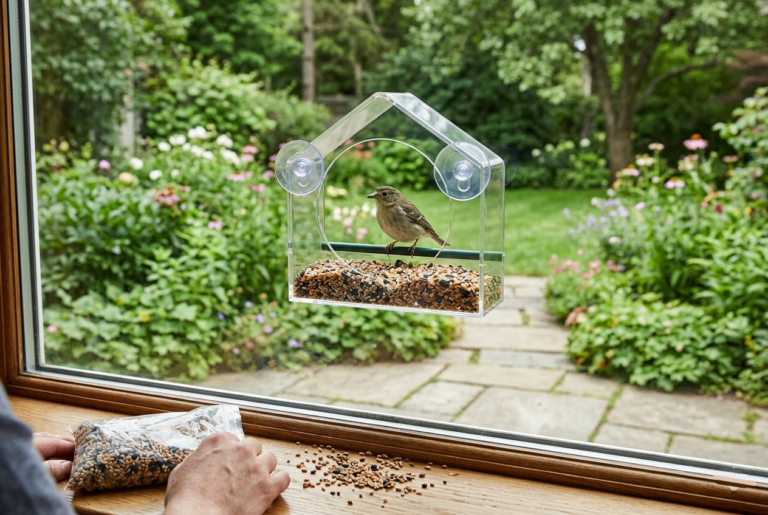
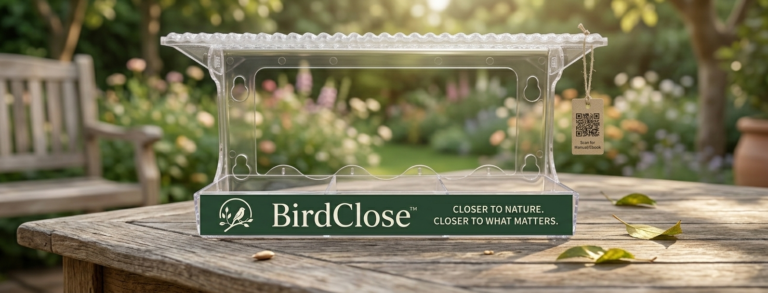
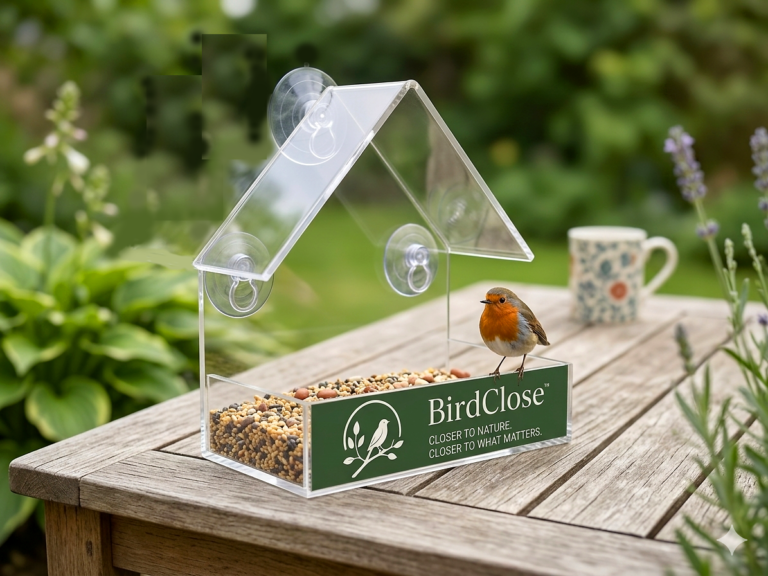
The BirdClose window bird feeder was engineered specifically as an extension of the modern workspace, balancing minimalist aesthetics with advanced avian ecology.
Constructed from premium, optical-grade, ultra-clear acrylic, the BirdClose feeder has no heavy wooden frames or opaque plastic backings to block your view. The structure is completely transparent, creating a “macrophotography effect.” The birds appear to be floating directly on your window glass, allowing you to see the fine-grain texture of their feathers and the intense expressions in their eyes with absolute clarity.
A common concern among animal lovers is the fear of window collisions. It is a well-documented tragedy that millions of birds fly into home windows every year due to the glass reflecting the open sky or nearby trees.
However, ornithological safety research has proven a fascinating rule: mounting a feeder directly onto the window glass is actually the safest configuration possible.
When a feeder is attached directly to the pane, oncoming birds must slow down to a gentle hover in order to land. When they depart, they cannot generate enough speed or physical momentum to injure themselves if they happen to brush against the glass. Furthermore, the physical presence of the feeder, the seeds, and the birds breaks up the reflection of the sky, acting as a clear visual warning that the window is a solid object.
True workspace efficiency means minimizing maintenance friction. A poorly designed feeder can retain rainwater, leading to damp, moldy seeds that are dangerous to avian health.
BirdClose solves this through a smart, multi-tiered structural design:
To get the absolute most out of your new visual wellness tool, its placement should be treated with the same intentionality as your monitor setup or your office acoustics.
Your creative ideas, analytical breakthroughs, and complex decision-making abilities constitute your primary professional capital. Forcing your brain through hours of unbroken digital stimulation, screen glare, and sensory isolation without structured intervals of recovery is an unsustainable way to work.
Upgrading your home office shouldn’t just be about increasing your processing power or expanding your digital screen real estate. True workspace optimization must include tools designed to care for the human mind operating the machine.
Don’t buy another digital gadget to fix a problem caused by digital overload. Turn your window into a living viewport to the natural world. Your focus, your eyes, and your local wildlife will thank you.
Upgrade Your Workspace – Explore the BirdClose Window Feeder